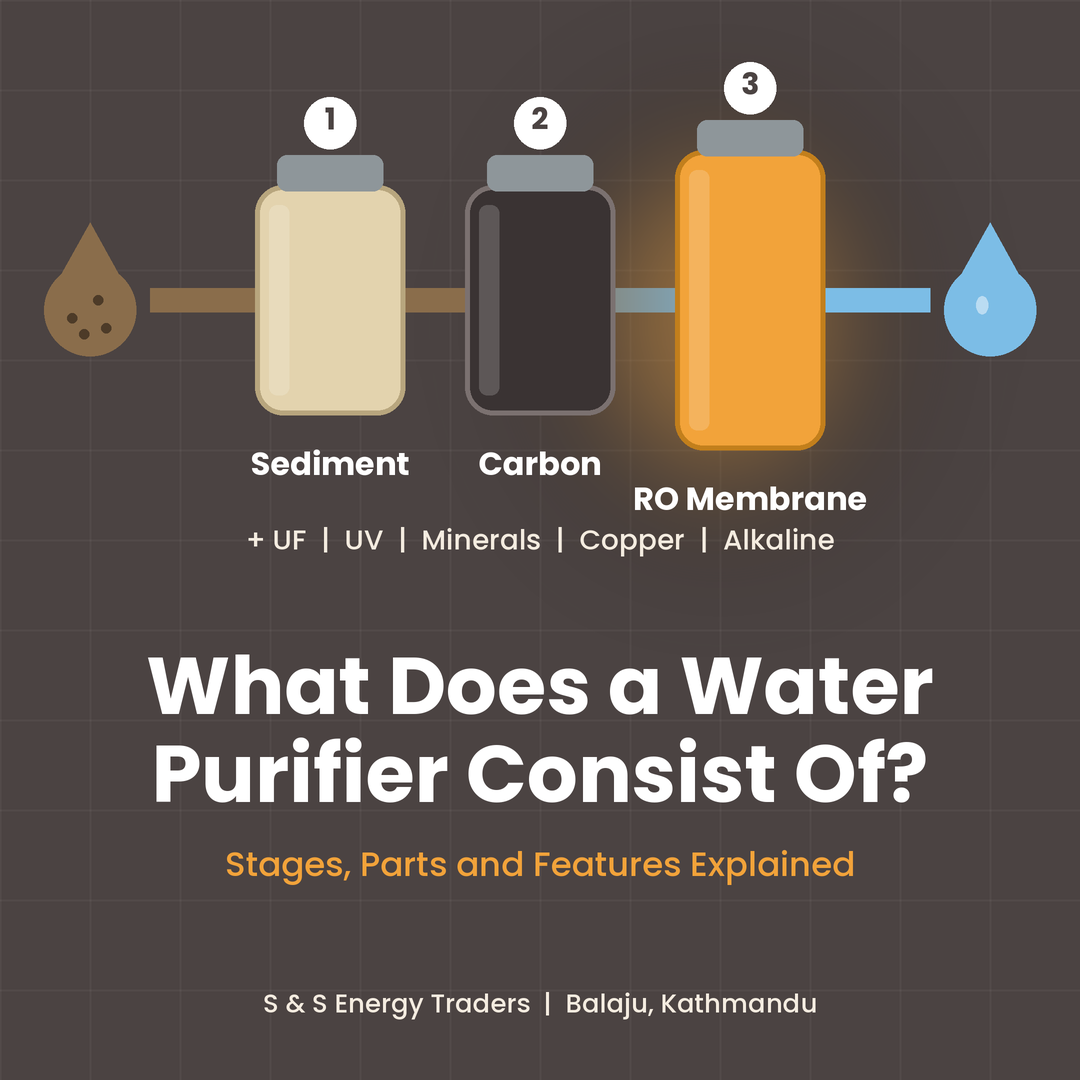
What Does a Water Purifier Consist Of ?
9-Stage Filtration Explained
A water purifier may look like a standard appliance with a tap, but inside, incoming water passes through multiple filtration stages designed to eliminate contaminants, improve taste, and balance mineral content.
Modern high-end purifiers feature multi-stage systems—often reaching up to 9 stages—utilizing specialized media for mineral restoration, copper infusion, and pH balancing.
Understanding the internal architecture of a purifier and how each filtration stage operates helps in choosing and maintaining the right system.
Main Components of a Water Purifier
Every modern water purifier relies on key structural, mechanical, and filtration components to ensure consistent output:
• Inlet Valve & Connection: Connects directly to the main water supply line or storage tank.
• Filter Cartridges: Houses physical and chemical media, including sediment, activated carbon, anti-scalant, mineral, copper, and alkaline cartridges.
• RO Membrane & Housing: High-pressure housing that holds the fine reverse osmosis membrane for heavy contaminant removal.
• UF Membrane: Hollow-fiber membrane module designed to capture micro-particles and biological impurities.
• UV Disinfection Unit: Features a inline UV lamp or an in-tank UV LED to continuously sterilize water.
• Booster Pump & Power Adaptor (SMPS): Elevates incoming water pressure to the necessary level for effective RO membrane operation.
• Solenoid Valve: Controls incoming water flow electronically and shuts off supply when storage is full.
• TDS Controller / Modulator: Controls total dissolved solids by blending controlled amounts of purified water.
• Storage Tank & Dispenser: Stores purified water safely and dispenses ambient, hot, or cold water through a tap or touch interface.
• Drain Line: Channels wastewater containing rejected salts and concentrated impurities away from the system.
• Control Board & Digital Display: Monitors system performance, manages auto-flushing cycles, and displays filter health and operational status.
Purifier Types & Selection Criteria
Choosing the correct purification setup depends on the Total Dissolved Solids (TDS) and contaminant levels of your source water:
• Reverse Osmosis (RO): Recommended for source water with high TDS levels (typically above 500 ppm), such as groundwater or borewell supply.
• UV + UF: Ideal for treated municipal tap water with lower TDS levels that requires protection against bacteria, viruses, and physical turbidity.
• Gravity-Based: Non-electric filtration designed for soft water areas to strain physical sediments and basic biological pathogens.
Typical 9-Stage Filtration Process
Here is how water moves sequentially through a comprehensive 9-stage purification system:
Stage 1: Sediment Filter
• Function: Spun or pleated media traps coarse suspended physical impurities down to approximately 5 microns.
• Target Contaminants: Sand, silt, dirt, pipe scale, and rust particles.
• Primary Role: Prevents downstream filters and pumps from clogging early.
Stage 2: Pre-Activated Carbon Filter
• Function: Uses high-surface-area activated carbon granules or blocks to adsorb chemical pollutants.
• Target Contaminants: Chlorine, pesticides, volatile organic compounds (VOCs), bad odors, and foul tastes.
• Primary Role: Removes harsh chlorine chemicals that break down thin-film composite (TFC) RO membranes.
Stage 3: Anti-Scalant Protection
• Function: Doses minute amounts of scale-inhibiting compounds into the feed water.
• Primary Role: Prevents hard minerals from forming calcified scale on the RO membrane surface, preserving flow rate and membrane lifespan.
Stage 4: RO (Reverse Osmosis) Membrane
• Function: A high-pressure pump forces water through a semi-permeable membrane with microscopic pores (~0.0001 micron).
• Target Contaminants: Dissolved heavy metals, salts, fluoride, nitrates, and microscopic chemical compounds.
• Output: Splits the flow into purified water and rejected wastewater. Advanced systems incorporate reject-water recovery loops to send wastewater to secondary domestic tanks.
Stage 5: UF (Ultrafiltration) Membrane
• Function: Utilizes hollow-fiber strands with ultra-fine pore structures.
• Target Contaminants: Fine suspended particles, cysts, and bacteria, operating without removing essential natural minerals.
• Primary Role: Serves as a physical secondary barrier following RO filtration.
Stage 6: UV Sterilization
• Function: Exposes water to ultraviolet light rays, disrupting the DNA of pathogens.
• Target Contaminants: Bacteria, active viruses, and microbial spores.
• Primary Role: Disinfects stream flow and uses optional in-tank UV LEDs to prevent stagnant water re-contamination.
Stage 7: Mineralization & TDS Control
• Function: Adds controlled amounts of vital minerals (calcium and magnesium) back into the purified water while balancing TDS levels.
• Primary Role: Corrects the flat taste typical of pure RO output and restores trace mineral balance.
Stage 8: Copper Infusion
• Function: Imparts precise, safe trace levels of ionic copper to the purified stream.
• Primary Role: Incorporates health-supporting properties and enhances water freshness naturally.
Stage 9: Alkaline & Post-Carbon Balancing
• Function: Infuses alkaline minerals to elevate pH levels while passing water through a final polishing carbon stage.
• Primary Role: Neutralizes acidity, balances pH towards mildly alkaline, and delivers a polished taste.
Integrated System Features
Modern multi-stage purifiers incorporate integrated smart features to improve usability and efficiency:
• Automated Membrane Flushing: Periodically rinses the RO membrane surface with high-speed water to remove accumulated salt build-up.
• Filter Life Monitoring & Alerts: Sensors track water throughput and usage time, providing visual or audible reminders for cartridge replacements.
• Water Recovery Technology: Minimizes drainage waste by routing reject water back into domestic supply lines or utility storage.
• Temperature Modulation: Integrated heating and cooling elements deliver instant ambient, chilled, or hot water on demand.
Recommended Maintenance Schedule
Regular cartridge replacements and maintenance ensure safe water quality and maintain optimum pressure:
Filter / Component : Recommended Service Interval
Sediment & Pre-Carbon Filters : Every 6 to 12 months
Anti-Scalant Media : Every 12 months
RO Membrane : Every 2 to 3 years (earlier for high-hardness water)
UF Membrane : Every 12 to 24 months
UV Lamp / LED Modules : Annually or upon system replacement alerts
Mineral, Copper & Alkaline Media : Every 6 to 12 months
Common indicators that service is required:
Reduced dispense flow rate, changes in taste or smell, persistent pump noise, unexpected leaks, or continuously running booster pumps.
Water Purifier Components and Work