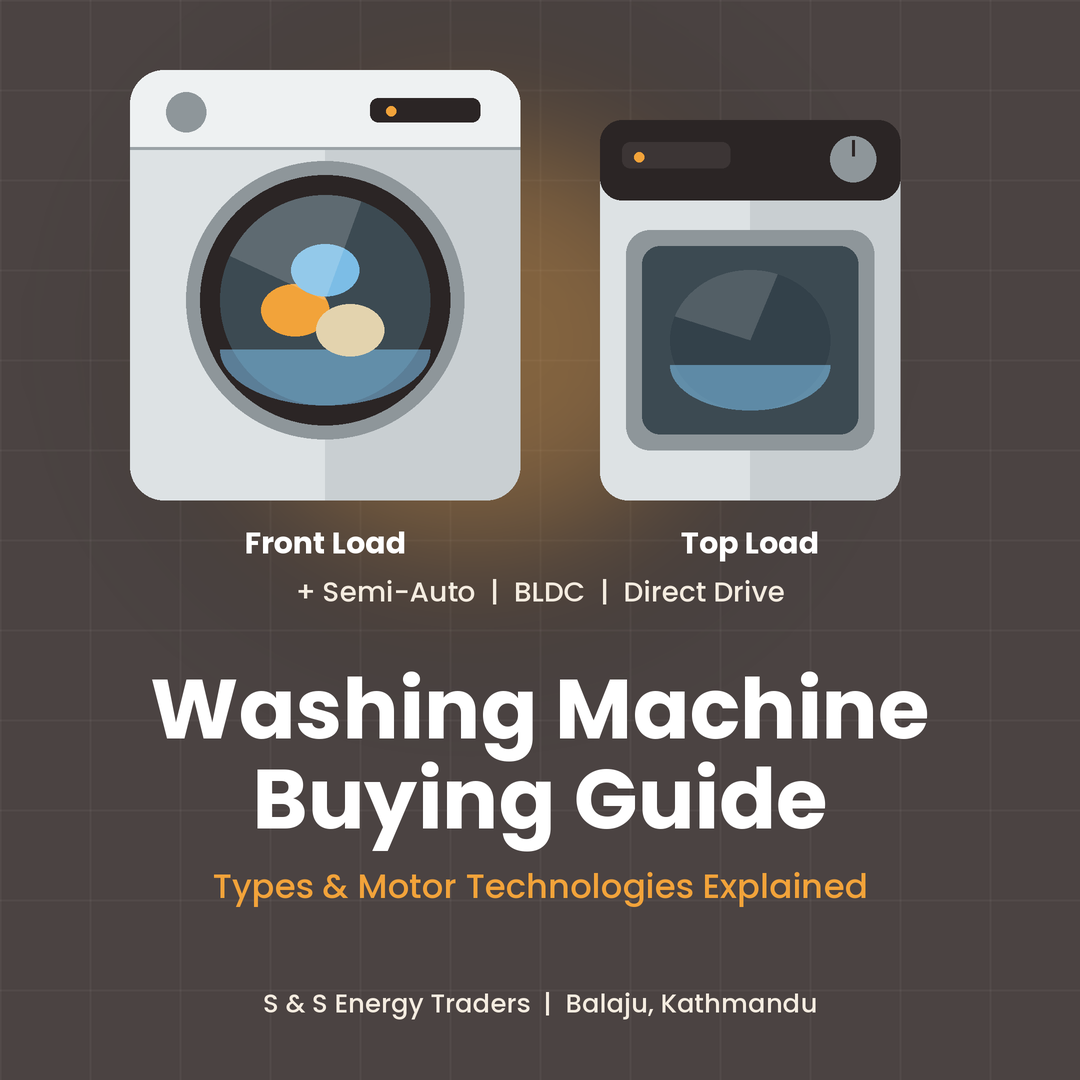
Washing Machine Buying Guide: Types and Motor Technologies Explained
When you choose a washing machine, two decisions matter most: the door type (front load, top load or semi-automatic) and the motor technology (BLDC or direct drive). Get these two right, and the rest, such as capacity and extra programs, becomes much easier.
This guide explains each option in plain language, with how it works, its main features and who it suits best.
1. Door type: front load, top load or semi-automatic
Front load washing machines
How it works: a horizontal drum tumbles clothes using gravity, lifting them and dropping them through water and detergent. This gives a gentle but deep clean.
Key features:
Typically uses noticeably less water and energy per wash than a top loader, often cited as 40% to 50% less, though results depend on the model.
Strong stain removal, and gentler on delicate fabrics.
Higher spin speeds leave clothes drier, so they dry faster.
Many models can be stacked, or have a worktop above them, to save space.
Ideal for: medium to large families, households that want to save water and power, delicate fabric care and modern laundry rooms.
Fully automatic top load washing machines
How it works: a vertical drum with a pulsator or agitator at the bottom circulates water and clothes quickly in a deep water bath.
Key features:
Easy to load and unload without bending down.
You can open the lid mid-cycle to add a forgotten garment (on most models).
Faster overall wash cycles.
Lower upfront cost than most front loaders.
Ideal for: elderly users or anyone with back pain, smaller budgets and fast daily laundry routines.
Semi-automatic twin-tub washing machines
How it works: two separate tubs, one for washing and one for spin-drying. You move the clothes from one to the other by hand.
Key features:
The most affordable type of washing machine.
Very low power consumption.
Full manual control over wash time and water reuse.
Does not need a fixed water connection, because you can fill it by bucket.
Ideal for: tight budgets, homes where water has to be filled by hand and quick, low-cost washing.
Door types at a glance
Water and power use: front load uses the least, top load uses medium to high, and semi-automatic uses very little power but manual water.
Cleaning feel: front load is gentle with a deep clean, top load is strong and fast, and semi-automatic gives you manual control.
Cycle time: front load is the longest, top load is shorter, and semi-automatic lasts as long as you choose.
Loading: front load needs bending, top load is easy from the top, and semi-automatic is easy but you move clothes by hand.
Upfront cost: front load is the highest, top load is medium, and semi-automatic is the lowest.
2. Motor technology: BLDC vs direct drive
The motor spins the drum, so it decides how efficient, quiet and durable your machine will be.
BLDC inverter motor (brushless DC)
How it works: an electronic brushless motor turns the drum through a heavy-duty drive belt.
Key features:
Much more energy efficient than a traditional brushed motor.
Longer motor life, because there is less friction and heat.
Low cost to repair, since a worn drive belt is cheap and easy to replace.
Ideal for: buyers who want high energy efficiency and quiet running at a mid-range price.
Direct drive (DD) motor
How it works: the motor connects directly to the back of the drum, with no belt, pulleys or extra moving parts.
Key features:
Ultra-quiet running, with little vibration at high spin speeds.
Precise drum movements that can be tuned to different fabrics.
Excellent long-term durability, since fewer parts can wear out.
Ideal for: open-plan apartments, night-time washing, heavy daily loads and anyone who wants top performance and very low noise.
Motors at a glance
Drive: a BLDC motor turns the drum through a belt, while a direct drive motor connects straight to the drum.
Noise and vibration: BLDC is quiet, and direct drive is ultra-quiet with the lowest vibration.
Durability: BLDC has a long life but the belt may need replacing, and direct drive has fewer parts to wear out.
Repair cost: BLDC is low, and direct drive can be higher if the motor itself needs repair.
Price: BLDC is mid-range, and direct drive is premium.
Other things to check before you buy
Capacity: a rough guide is about 6 to 7 kg for a family of 3 to 4, and 8 kg or more for larger families or heavy items like blankets. Check the manufacturer's recommendation.
Wash programs: look for programs you will use, such as quick wash, delicates, heavy duty and a rinse-and-spin option.
Water connection: fully automatic machines need a steady water supply with adequate pressure. If your supply is irregular, a water tank above the machine or a booster pump may help.
Power supply: a voltage stabilizer protects the control board from surges, which are common during load changes.
Space: measure the spot, including space for the door to open (front load) or the lid to lift (top load).
Warranty and service: check what is covered, especially the motor, and make sure local service is available.
Quick picks
Want the lowest price? Choose a semi-automatic twin tub.
Want easy loading and fast cycles? Choose a fully automatic top load.
Want the best clean and lowest water use? Choose a front load.
Want efficiency at a sensible price? Choose a BLDC inverter motor.
Want the quietest, most durable machine? Choose a direct drive motor.
Keep it running well
Clean the lint filter and detergent drawer regularly.
For front loaders, wipe the door seal and leave the door ajar after washing so moisture dries out.
Run an empty hot cycle with a washing machine cleaner every month or two to remove build-up.
Do not overload the drum, because it strains the motor and bearings.
Level the machine on a flat floor, which reduces noise and vibration.
Have it serviced once a year.
Washing Machine Buying Guide: